+86-576-82686004
 allen@badavalve.com / daisy@badavalve.com



 EN
EN
 Español
The performance characteristics of 90° elbow brass fittings begin with their base material. Brass, an alloy primarily composed of copper and zinc, is selected for these components due to its balance of mechanical strength, corrosion resistance, and machinability. The specific alloy designation commonly used for plumbing and fluid handling fittings is C37700 or C36000, which contains approximately 57 to 61 percent copper, 35 to 39 percent zinc, and small additions of lead (2.5 to 3.5 per cent) to enhance machinability. This composition yields a material with tensile strength ranging from 330 to 450 megapascals, depending on temper and processing.
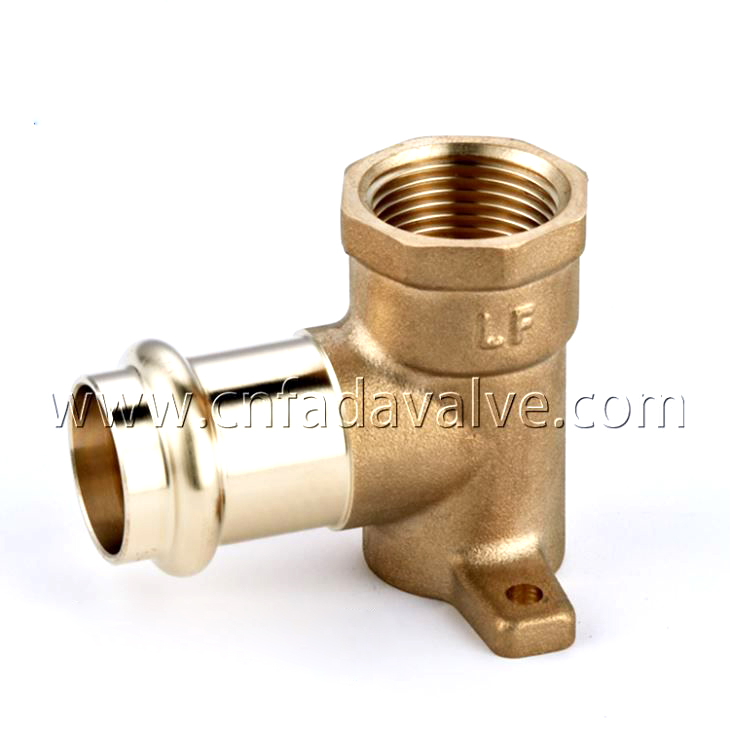
The metallurgical structure of brass contributes to its suitability for elbow fittings in several ways. The alloy exhibits good ductility, allowing it to withstand the stresses of thread cutting and compression fitting assembly without cracking. Its corrosion resistance in potable water systems stems from the formation of a stable surface oxide layer, though brass with higher zinc content may be susceptible to dezincification—a selective leaching of zinc that leaves behind a porous, weakened copper structure. To address this, manufacturers now offer dezincification-resistant (DZR) brass alloys, sometimes referred to as “DR brass,” which incorporate small amounts of arsenic or other elements to inhibit this process. Such materials are specified for applications involving aggressive water chemistry or for installations where long-term reliability is required.
From a manufacturing perspective, the material properties of brass enable efficient production of 90° elbows through several processes. Forged brass elbows, formed by forcing heated metal into a die under pressure, offer density and grain structure compared to cast alternatives. Forging aligns the metal's grain flow with the contour of the fitting, reducing stress concentrations at the bend. Machined elbows, produced from extruded brass bar stock, rely on the material's machinability—C36000 brass is rated at 100 percent machinability, serving as the benchmark against which other metals are compared. This machinability allows for precise thread cutting, consistent wall thickness, and tight dimensional tolerances essential for leak-free connections.
Design Geometry and Fluid Dynamics
The 90° elbow configuration represents a fundamental geometry in fluid conveyance systems. While its function—changing flow direction by a quarter turn—appears straightforward, the design details significantly influence system efficiency and longevity. The internal geometry of a brass 90° elbow affects pressure drop, flow rate, and susceptibility to erosion.
Key design characteristics affecting performance:
Bend radius: The curvature of the internal flow path determines the severity of directional change. Elbows with a tighter radius create more abrupt flow redirection, resulting in higher pressure loss and localised turbulence. Standard 90° brass elbows typically have a centerline bend radius equal to the nominal pipe diameter, though long-radius versions (1.5 times the diameter) are available for applications requiring reduced pressure drop.
Internal surface finish: As-cast or as-machined interior surfaces introduce frictional resistance to flow. Higher-quality brass elbows feature smooth internal bores with consistent diameter throughout the bend. Rough surfaces or parting lines from casting processes can create points of turbulence and serve as initiation sites for sediment accumulation or scale formation in water systems.
Wall thickness uniformity: Consistent wall thickness around the bend ensures structural integrity under pressure. During forging or casting, the outer radius of the elbow experiences thinning while the inner radius undergoes compression. Proper die design and process control maintain wall thickness within specified tolerances, typically 0.5 to 1.5 millimeters depending on nominal size and pressure rating.
Thread or connection geometry: Elbows are manufactured with various connection types. Threaded elbows conform to standards such as ANSI/ASME B1.20.1 for National Pipe Thread (NPT), which features tapered threads that create a mechanical seal through thread deformation. Compression connection elbows use straight threads with a ferrule that compresses against the tubing. Each geometry imposes different assembly requirements and torque specifications.
From a fluid dynamics standpoint, the pressure drop across a 90° elbow is expressed as an equivalent length of straight pipe. For standard brass elbows in water systems, the equivalent length typically ranges from 20 to 40 pipe diameters, depending on flow regime and Reynolds number. This factor must be accounted for in system design to ensure adequate flow rates and pump sizing.
Connection Methods and Installation Requirements
The reliability of a 90° brass elbow installation depends largely on the connection method employed and the quality of assembly. Different connection types serve distinct applications, each with specific installation protocols.
Threaded connections remain the common method for brass elbows in residential and commercial plumbing. National Pipe Thread (NPT) fittings rely on tapered threads that achieve sealing through thread deformation. Proper installation requires the application of pipe thread sealant—either PTFE tape or pipe dope—to lubricate threads during assembly and fill microscopic gaps. Over-tightening presents a significant risk; applying torque beyond manufacturer specifications can distort threads, crack the fitting, or impose excessive stress on adjacent pipes. Recommended practice involves tightening by hand until resistance is felt, then using a wrench for an additional one to two full turns, depending on pipe size. Threaded elbows should be supported with pipe hangers or brackets to prevent vibration or thermal expansion from transferring stress to the fitting.
Compression connections offer an alternative for applications requiring a mechanical seal without threading. The assembly consists of a brass elbow body with straight threads, a compression nut, and a ferrule (often brass or copper). When the nut is tightened, the ferrule compresses against both the tubing and the fitting body, forming a watertight seal. Compression elbows are commonly used in exposed installations—such as under sinks or for appliance connections—because they allow for disassembly without damaging threads. Correct installation involves inserting the tubing fully into the fitting, tightening the nut finger-tight, then applying an additional three-quarters to one full turn with a wrench. Over-compression deforms the ferrule excessively and may restrict flow.
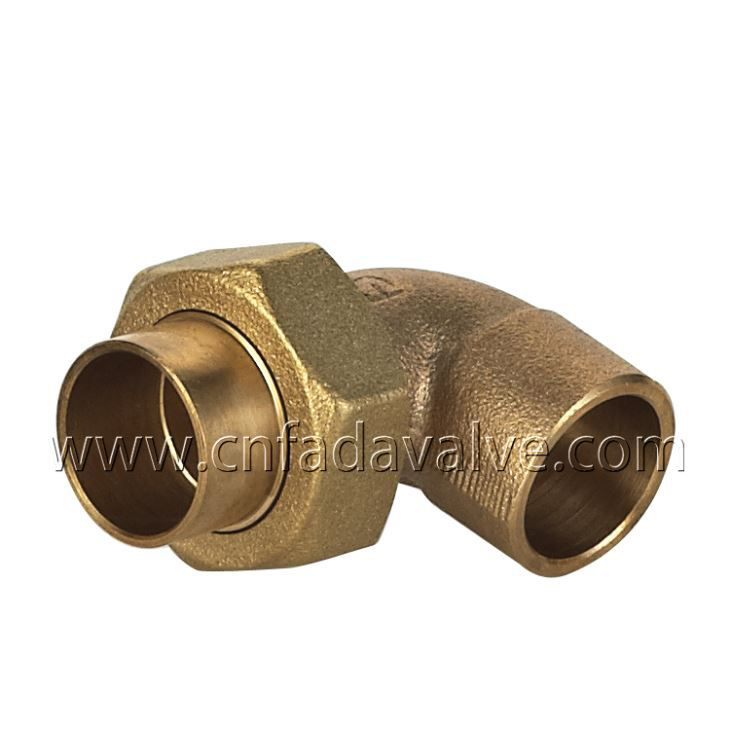
Soldered or brazed connections are available for brass elbows intended for copper tube systems. In these applications, the elbow features socket ends designed to accept copper pipe. Assembly requires cleaning the pipe and fitting surfaces with abrasive cloth, applying flux, heating the joint with a torch, and introducing lead-free solder. Proper heat control prevents overheating the brass, which can cause dezincification or weaken the fitting. This connection method provides a permanent, leak-resistant joint suitable for concealed installations.
Regardless of connection type, material compatibility must be verified. Brass elbows should not be directly joined to galvanised steel in potable water systems without a dielectric union, as the dissimilar metals create a galvanic cell that accelerates corrosion of the steel component.
Application Contexts and Failure Modes
The selection of a 90° brass elbow for a given application requires consideration of operating pressure, temperature, fluid chemistry, and mechanical stresses. When correctly specified and installed, these fittings provide service lives exceeding 50 years in many residential and commercial applications. However, several common failure modes can reduce service life.
In potable water distribution, brass elbows function at typical pressures of 40 to 80 pounds per square inch (psi) and temperatures ranging from 4°C to 60°C. For these conditions, standard forged or machined brass elbows rated at 400 psi (for smaller diameters) or 150 psi (for larger diameters) provide adequate safety margins. In heating systems such as hydronic radiant floors or baseboard radiators, operating temperatures may reach 85°C to 95°C. Elevated temperatures reduce the pressure rating of brass; derating factors typically reduce allowable working pressure by 20 to 30 percent at operating temperature.