+86-576-82686004
 allen@badavalve.com / daisy@badavalve.com



 EN
EN
 Español
Press fit bronze tees are manufactured in several configurations to accommodate different piping layouts and system requirements. The selection depends on the direction of flow, the pipe sizes being connected, and the specific installation constraints.
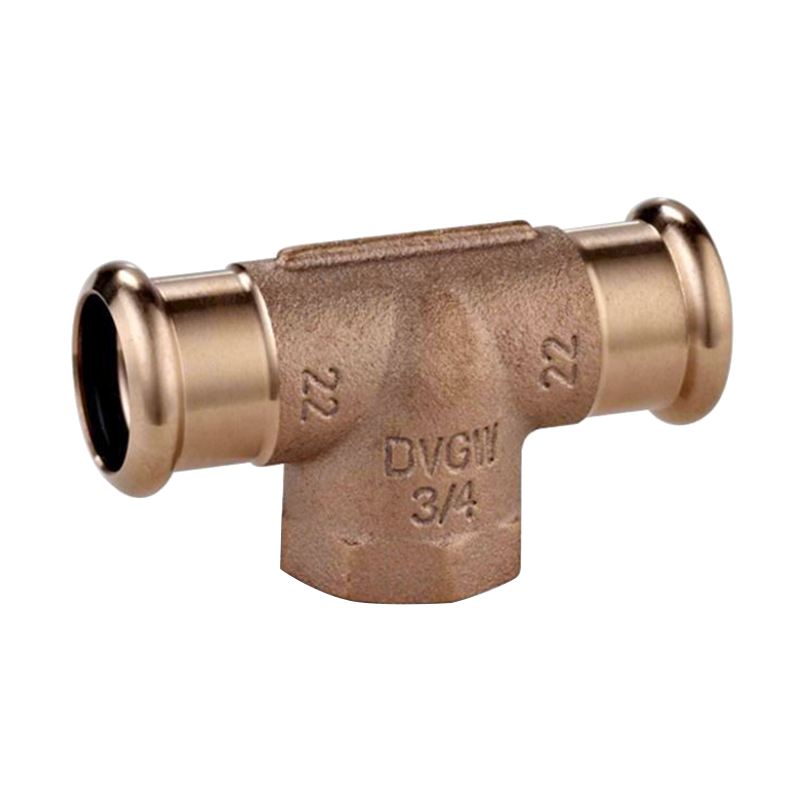
Equal Tee Configuration:
Description: In an equal tee, all three openings have the same nominal diameter. For example, a one-inch equal tee accepts one-inch pipe on the run ends and the branch outlet.
Application: This configuration is used when the branch line requires the same flow capacity as the main line. Common applications include main distribution lines where branch circuits carry the full system flow, such as in commercial kitchen supply lines or industrial process piping.
Installation Consideration: The pressing tool must access all three connections. In tight spaces, the orientation of the tee may need to be planned so that the pressing jaws can reach each end without interference from walls or other obstructions.
Reducing Tee Configuration:
Description: A reducing tee features a branch outlet that is smaller in diameter than the run ends. For instance, a one-inch by one-inch by three-quarter-inch tee has one-inch run connections and a three-quarter-inch branch.
Application: Reducing tees are specified when the branch line serves a lower-flow fixture or equipment than the main line. Residential and commercial plumbing frequently uses reducing tees for fixture supplies, water heater connections, and appliance branches.
Installation Consideration: The different end sizes require different pressing jaws or tool settings. Installers must verify that the pressing tool is equipped with the correct jaw for each connection size before proceeding.
Configuration by Port Arrangement:
Standard Tee: The branch outlet is oriented perpendicular to the run, creating a T-shaped fitting.
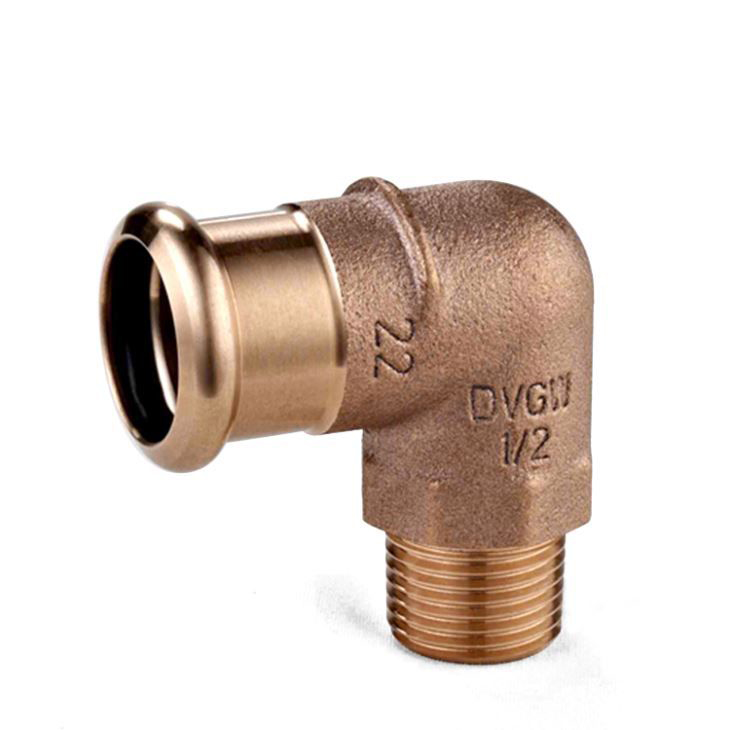
Street Tee: One end of the run or the branch has male threads or a plain end that inserts into another fitting, eliminating the need for an additional coupling.
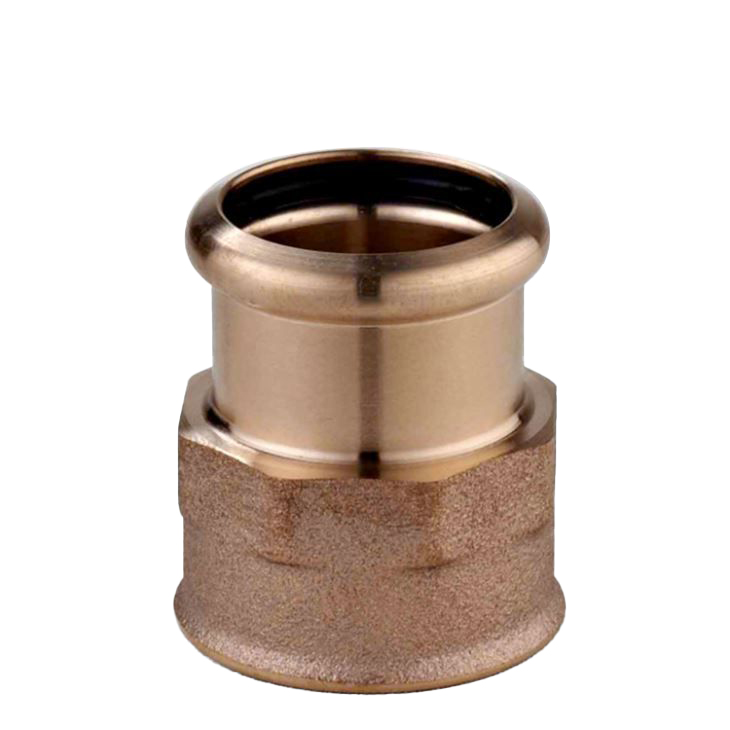
Transition Tee: This configuration combines press fit connections on some ends with threaded or soldered connections on others. For example, a tee might have press fit run ends for connection to copper tubing and a threaded branch outlet for attaching a threaded valve or gauge.
Material and Coating Variations:
While the body is bronze, some manufacturers offer tees with different surface treatments. Uncoated bronze develops a natural patina over time but is otherwise suitable for direct burial or exposure. Some tees feature an epoxy coating for additional corrosion protection in aggressive soil conditions or industrial environments. The coating color may indicate the intended application, such as blue for potable water or yellow for gas.
How do you properly install a press fit bronze tee fitting?
Proper installation of a press fit bronze tee begins with pipe preparation. The pipe ends must be cut square, meaning perpendicular to the pipe axis, to ensure full insertion depth and even contact with the O-ring inside the fitting. A tubing cutter designed for the pipe material produces the cleanest, squarest cut. After cutting, the outside of the pipe end must be deburred and cleaned. Burrs can scrape or displace the O-ring during insertion, bring about leaks. A chamfering tool or deburring blade removes sharp edges and creates a slight lead-in angle. The pipe surface should be wiped clean of dirt, oil, and debris. Some manufacturers recommend a specific cleaning fluid, but generally, a clean dry cloth suffices.
Marking the insertion depth is a critical step. Each tee fitting has a specified depth to which the pipe must be inserted for the press to create a proper seal. This depth is typically marked on the fitting itself or provided in the manufacturer's specifications. Using a marker or tape, the installer transfers this measurement to the pipe. After marking, the pipe is inserted into the tee fitting until the mark aligns with the end of the fitting. Resistance may be felt as the pipe passes the O-ring, and the pipe should be rotated slightly during insertion to ensure the O-ring is not rolled or displaced.
The pressing operation requires the correct tool and jaw set. Pressing tools are specific to fitting brands and sizes, though some compatibility exists among manufacturers. The jaw must be sized exactly to the fitting being installed. The jaw is placed over the fitting, ensuring it is properly seated against the stop or alignment feature on the fitting body. The tool is then actuated, completing one full pressing cycle. Many tools provide audible or visual confirmation when the cycle is complete and the proper force has been applied. After pressing, the joint should be inspected to confirm that the fitting has deformed uniformly and that the pipe remains fully inserted. Many fittings include press indicators, such as small paint dots that are displaced or gaps that close, providing visual confirmation of a complete press.
What are the common applications for press fit bronze tee fittings?
Press fit bronze tees are used across multiple sectors of the construction and mechanical industries. In commercial plumbing, they distribute domestic hot and cold water throughout office buildings, hotels, and hospitals. The speed of installation and the ability to make connections in occupied buildings without shutting down entire systems makes them particularly valuable in renovation work and tenant fit-outs. In hydronic heating systems, these fittings connect radiant floor heating loops, baseboard radiators, and panel radiators to main supply and return lines. The bronze material withstands the temperatures and pressures typical of closed-loop heating systems while resisting corrosion from treated water.
Industrial applications include process piping for food and beverage production, where the corrosion resistance of bronze meets sanitation requirements and the press fit technology allows for rapid installation during planned shutdowns. Compressed air systems also utilize bronze press fit tees, though installers must verify that the specific fitting is rated for compressed air service, as some O-ring materials are not compatible with compressor oils. Fire sprinkler systems represent a growing application area, with bronze press fit fittings approved for use in certain NFPA 13-compliant systems. The elimination of open flames during installation addresses fire safety concerns inherent in torch-soldered fittings.
How do you troubleshoot issues with press fit bronze tee connections?
When a press fit connection fails or leaks, systematic troubleshooting identifies the cause. The common issue is incomplete pressing. If the pressing tool did not complete a full cycle due to low battery, mechanical malfunction, or operator error, the fitting may not be fully deformed. The solution is to re-press the fitting using a fully charged tool and ensuring the jaw is correctly positioned. If the fitting has already been pressed once, re-pressing is sometimes possible, but manufacturer guidelines must be followed, as some fittings are designed for a single press only.
Improper pipe insertion causes a significant portion of installation failures. If the pipe was not inserted to the full depth mark, the O-ring may not align with the sealing surface, or the gripping teeth may not engage the pipe correctly. In this case, the fitting must be cut out and replaced, as attempting to press an incorrectly inserted fitting will not create a proper seal. Pipe surface defects, including longitudinal scratches deeper than the manufacturer's allowable limit, can create leak paths past the O-ring. Inspection of the removed pipe end often reveals such damage, indicating that the pipe should have been cut back to sound material before installation.